WASHINGTON — It’s the holiday season, the time to gather with family and old friends, even people with whom you don’t see eye-to-eye politically. This year that may have special meaning.
Geographic self-segregation — the difference between where Democrats and Republicans tend to live — has come to define American politics. But when combined with the pandemic, those geographic divides have real-world public health impacts.
After 20 months of Covid protocols, many families and friends are traveling and getting together for the first time in a long time and they are bringing with them different attitudes about the virus and the vaccine. Add it up and it could mean the country is due for another post-holiday season surge.
The change in travel plans around Thanksgiving this year tells the story. More than 53 million Americans were planning to take to the road and the skies this past week, according to AAA.
That’s an increase of more than 6 million people compared to last year, before there was a vaccine and before Americans had gotten exhausted by the pandemic.
The figures show there is still some hesitancy around travel. Back in 2019, the same AAA survey found 56 million Americans were going to travel for Thanksgiving. But this year’s number still represents a 13 percent increases from 2020. It shows more people are breaking out of their community bubbles to see people from other places.
And that’s where the political and health differences come into play.
Every holiday season, scores of articles are written about how to talk about politics with those you disagree with, but this year those differences may well include a different Covid vaccination status for Uncle Bob or Aunt Dora.
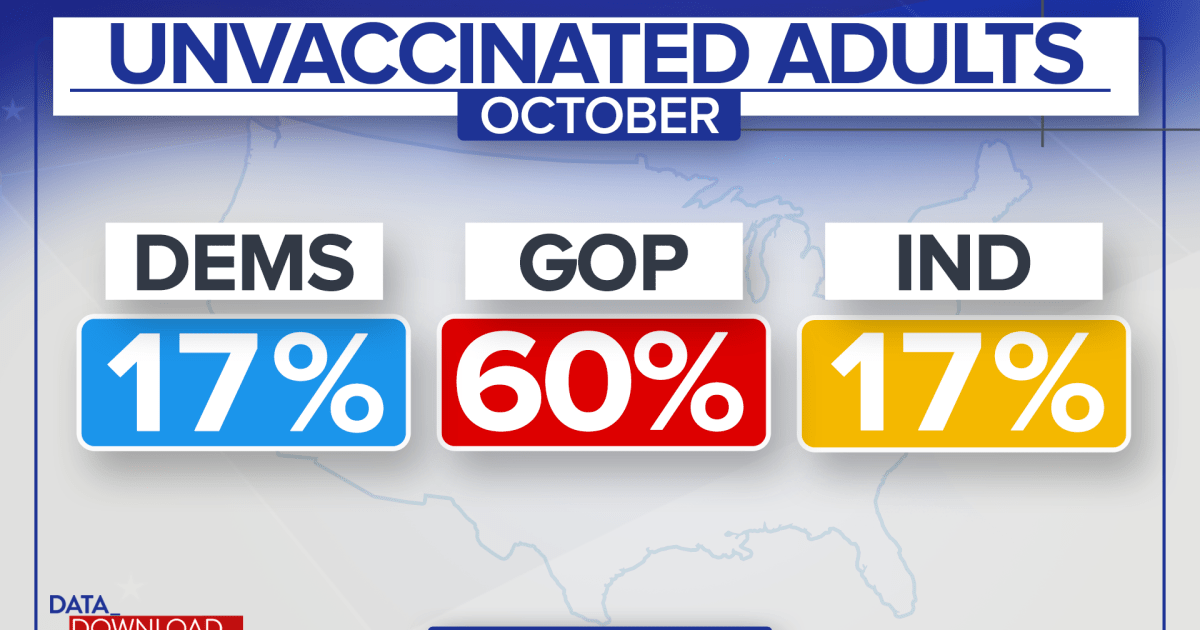
As of late October, the Kaiser Family Foundation reported that 27 percent of American adults had not received a single vaccine dose. But the partisan divide in that 27 percent was remarkable — 17 percent of them were Democrats, 17 percent of them were independents and a whopping 60 percent were Republicans.
So, in some cases, the awkwardness of holiday conversations has risen to a whole new level. Before you start talking about Congress or the White House you might want to ask if your tablemate has his or her vaccination card handy.
And it’s not just about sitting around the table together or sharing the punchbowl that provides a Covid challenge. The point of travel is to pull you out of your environment into someplace different and even if everyone at your destination is vaccinated, there is still getting from point A to point B, which can be fraught.
For instance, consider Mecklenberg County and Stanly County in North Carolina.
The two places are less than a half-hour apart by car, but the political and Covid differences between them are stark. President Joe Biden won Mecklenberg by 35 percentage points and 59 percent of the total population has had two vaccinations. Former President Donald Trump won Stanly by 51 points and fewer than 40 percent of the population is fully vaccinated.
And the phenomenon is not limited to North Carolina.
In Denver, which Biden won by 62 percentage points, 72 percent of the population is full vaccinated. Meanwhile, in nearby Elbert County, which Trump won by 50 points, only 36 percent have received both doses.
There are similar patterns around the country from Tennessee to Kansas to California — “blue” counties with high vaccination rates near “red” counties with the opposite.
The unfortunate reality is that the pandemic has become politicized and this year the holiday season seems primed to show the impacts of that politicization as we emerge from our respective political bubbles and interact.
The American Communities Project recently found that urban areas that are more likely to vote Democratic are also more likely to have higher percentages of people who are fully vaccinated. But even the “bluest” high-vaccinated cities area connected by highways that run through very “red” low-vaccinated areas.
In short, even if you are vaccinated and visiting people who are vaccinated, the airports and rest stops and restaurants you visit along the way are likely to be filled with a cross-section of people holding different beliefs about politics and the virus that has disrupted life.
It all serves as a reminder that no political bubble is airtight. We may increasingly live near and socialize with people who share our views, but the fates of red and blue America are more tightly intertwined than either side probably wants to admit.
This content was originally published here.