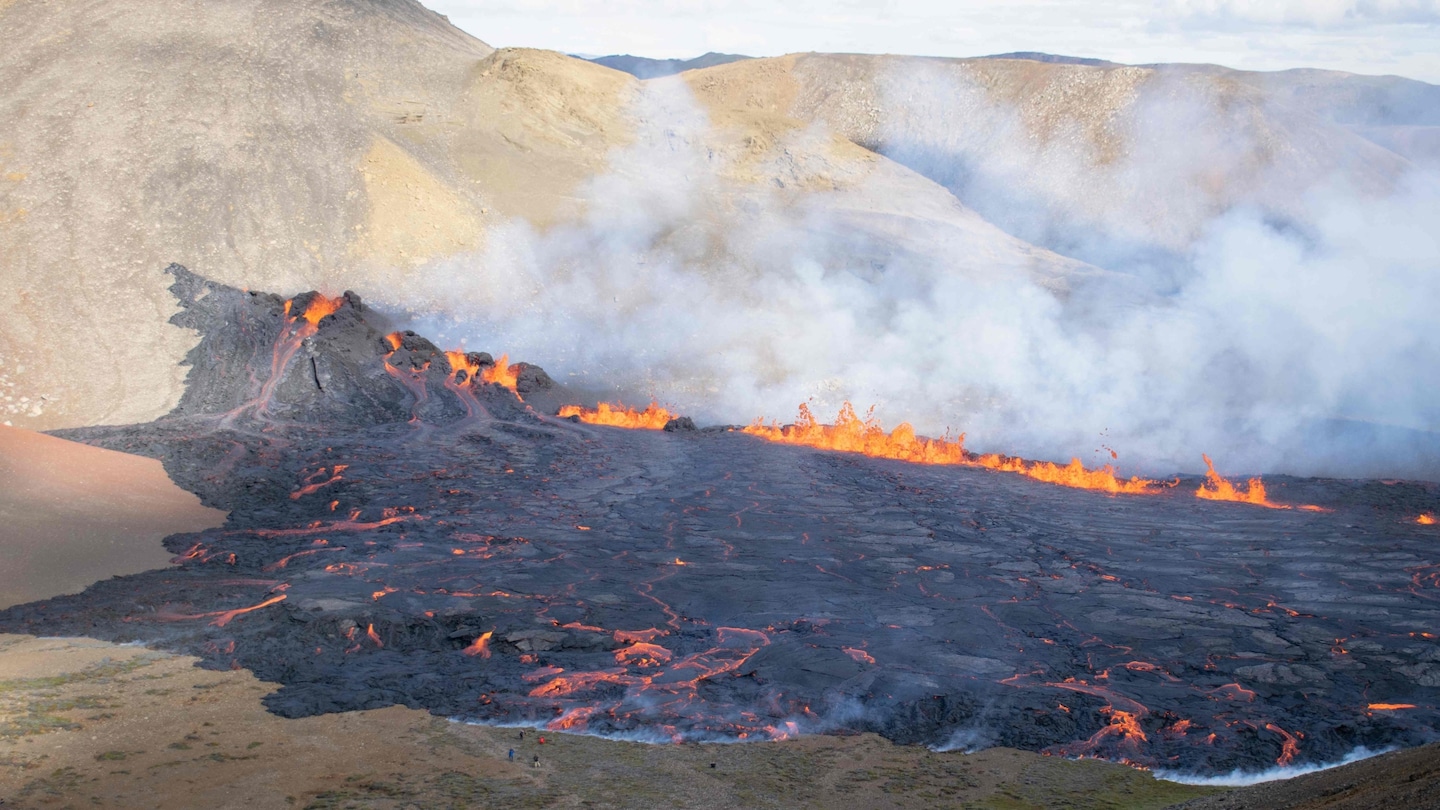
A massive volcano erupting close to a global travel hub, Iceland’s Keflavik Airport, led to close monitoring by officials and sparked fascination from people who ventured near the bright orange lava flows despite warnings.
The Fagradalsfjall volcano in southwest Iceland erupted Wednesday at 1:18 p.m. local time, according to the Icelandic Meteorological Office, which urged people to stay away from the sparsely populated area on the Reykjanes peninsula — though some still went up close to snap photographs with their children and fly drones.
“I just made it to the volcano … my mind is completely blown, it’s crazy,” one onlooker told the Associated Press. “The last thing that I would have imagined this morning when I woke up would be to be standing and looking at this … it is so beautiful.”
The eruption, classified as a volcanic fissure, is occurring about 10 miles from Keflavik International Airport and about 20 miles from the country’s capital, Reykjavik. As of Thursday morning, the airport — which has flights from Seattle, London and Frankfurt — remained open and operational.
“What we know so far is that the eruption does not pose any risk to populated areas or critical infrastructure,” Icelandic Prime Minister Katrin Jakobsdottir said in a statement. “We will of course continue to monitor the situation closely.”
A volcanic fissure does not usually result in large explosions or significant dispersal of ash into the stratosphere. But people were warned to stay away because of the risk from noxious fumes and hot magma.
“The eruption follows intense seismic activity over the past few days,” the Foreign Ministry said. “It is considered to be relatively small and due to its location, there is low threat to populated areas or critical infrastructure”
Volcanoes are a fact of life in Iceland, a country that sits atop the Mid-Atlantic Ridge, caused by the separation of the North American and Eurasian tectonic plates. On average, the country experiences a volcanic event about every four years.
However, the same geological activity is also responsible for some of the country’s most dramatic natural features, such as black sand beaches and geothermal lagoons, which draw millions of foreign tourists.
The current volcanic response is being led by Iceland’s department of Civil Protection and Emergency Management alongside the Meteorological Office and University of Iceland. Scientists are also in the area with Coast Guard helicopters to assess the situation, the government said.
This content was originally published here.