We all had our “thing” in lockdown. Mine was patriotism: a need to stoke my spluttering identity. I learnt Hiligaynon, my mother’s language. I cooked adobo and tocino, the vinegary, marinated meat dishes of my childhood. I devoured Victorian travel diaries written by some of the first British expats to the Philippines: diaries that told of Spanish plazas and bamboo forests and oceans the colour of sea glass. Even so, I wondered whether it had all been a dream.
You may rightly accuse me of bias, but evidence suggests that I’m not the only one taking an interest in this nation of more than 7,000 islands. Two big hotels — Hotel Okura and the Admiral by MGallery — opened in Manila last year. Bicol airport opened just outside Legazpi on a Pacific peninsula in 2021, with the first international flights scheduled for this year. The tourism board reached its 2022 target of 1.7 million visitors in October — three months ahead of schedule.
Still, the Philippines receives fewer visitors than other Southeast Asian countries, which means that those who do go receive a welcome that’s warmer, more generous and more genuine than anything its more polished neighbours can offer. “I had no idea it was like that,” is a common refrain I hear from those who make it there.
This reaction is partly down to the Philippines’ unique history. It was Spain’s only significant Asian colony and was later occupied by the Americans from 1898 to 1946 — their first foray into empire. The latter gave the Philippines one of its two official languages: English (the other is Filipino). For the traveller, this means it’s hard to get truly lost.
Rizal was a genius: a polymath poet and writer who campaigned for the representation of Filipinos in the Philippines’ Spanish-dominated parliament. Seeking a scapegoat for the pro-independence uprising triggered by Andrés Bonifacio (another national hero), the Spanish executed Rizal by firing squad in 1896. His face is now on the one-peso coin, as well as a hoodie I’ve kept since I was 15.
The moss-furred walls of Rizal’s cell have partly tumbled away; his bronze likeness stands there, looking defiantly outward. His clothes are the same as I’ve seen in photos of his execution: black suit, white shirt, derby hat. As the Spanish guns fired Rizal shouted, “Consummatum est!” — it is over.
Although it would take another five decades to achieve it, Rizal would be pleased to know that the fight for independence was far from over.
As the sky above Manila deepens to the colour of a ripe mango, I bid him farewell and take to the streets. Right now it’s Christmas — a season that stretches from September into January in this most Catholic of countries — so the streets are festooned with parol: luminous stars made from capiz oyster shells. Their lights bloom red, blue, green in the vinegar-infused steam rising from street-food stalls. Women gossip at long, linoleum-covered tables, enjoying the freedom for which Rizal gave his.
Seeking drama of a different sort, I leave Manila’s neon-scribbled skyline behind and take a short flight south to Bicol: a peninsula on the Pacific Ring of Fire, its northeast shoulder exposed to the “Amihan” trade winds that bring monsoons and typhoons. From above, I see the scars carved by Bicol’s 12 volcanoes; trees appear cowed, as if in supplication. This is the Philippines’ wettest, windiest region, particularly between November and February — there was some flooding there over Christmas, though the area I visited remained unaffected and this time it was more southerly Mindanao that bore the brunt. More sensible travellers than me will visit outside this period.
Unsurprisingly, this land of extremes is a popular adventure tourism destination among Filipinos. Over four days I try wakeboarding, cave swimming and paddle boarding — but the absolute must-not-miss experience, I’m told, is driving an ATV (quad bike) over the black lava fields of Mt Mayon.
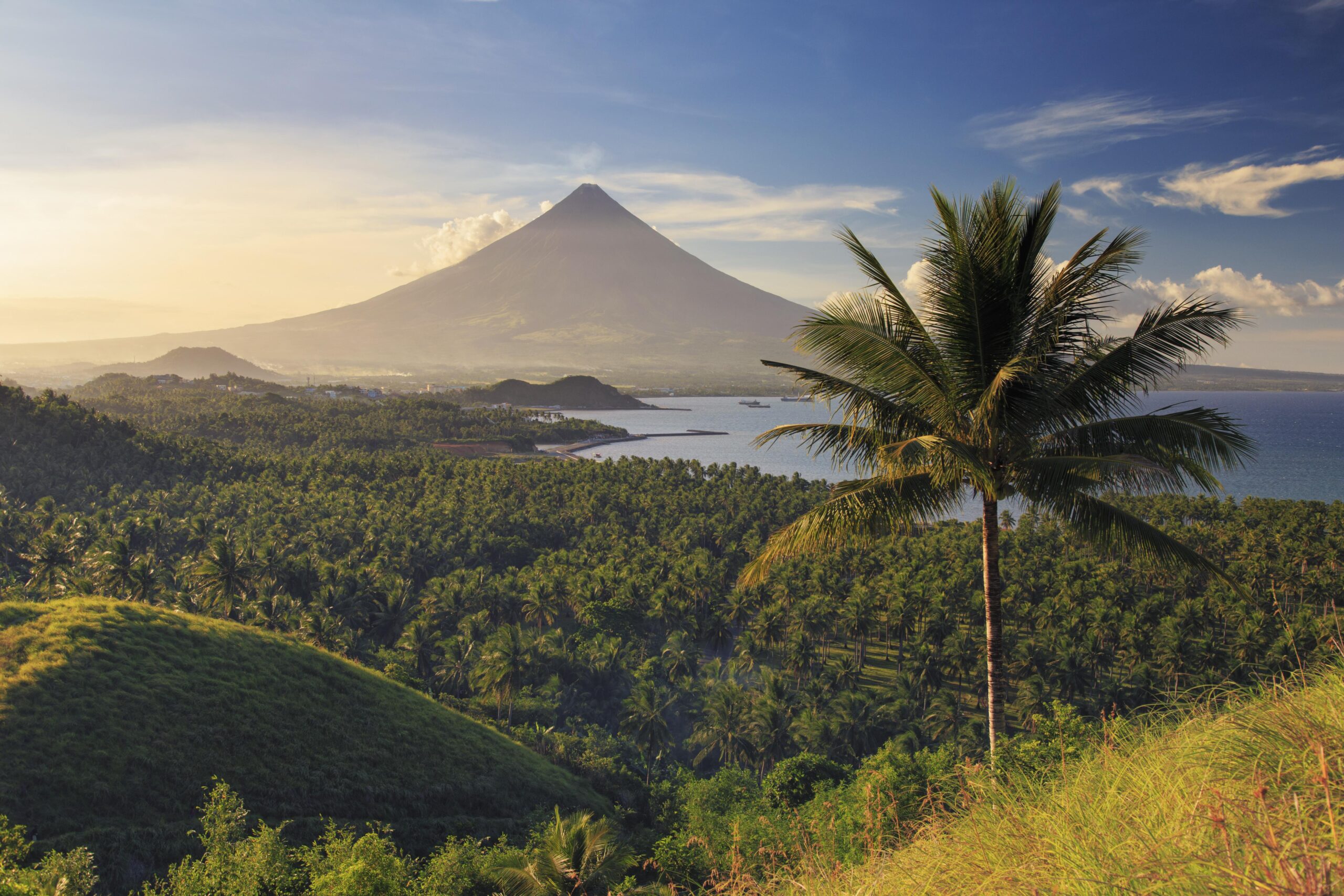
In a landscape defined by its eccentricity, Mayon is the exception: the world’s most perfect cone volcano, more flawless than Japan’s Mount Fuji and the subject of countless Bicolano legends. As I set out on a group ATV tour, I try to forget that it last erupted as recently as 2018.
It all starts smoothly enough. The black trails are flat and wide, flanked by the coconut palms that grow so well in this volcanic soil. Mayon’s peak is wreathed in cloud, yet she seems to watch over us, guiding us over joint-rattling rocks and through monsoon-swollen streams.
But as night falls, the rain begins. And I, a lifelong atheist, can think of only one word to describe it: biblical.
I’m drenched in seconds, my clothes clinging like a second skin. The rain falls not in drops but in pearlescent sheets, behind which palm trees and other ATVs become vague, shifting patterns of shadow and light. Black shadows, black sky, black road — all is black, black, black.
In this land of fire and water there is room for neither fear nor doubt. I fly over boulders and through rivers — crying or laughing, I’m not sure which — and let Mayon decide my fate.
She lets me survive, this time, but I’m soaked and shivering. I submit to the warmth of Casa Simeon, a Spanish-American-style guesthouse in Bacacay, named for the man who built it in 1927. It’s managed by his grandson Rico Calleja and his wife, Jessica Noelle Wong, who greets me at the door. I feel a thrill of nostalgia as I step onto the polished, barayong-wood floor. To me the house is a montage of childhood memories: the wrought-iron railings, the mahjong set on the veranda, the library stuffed with books in three languages.
The food, however, is unfamiliar. One of the great joys of Philippine travel is discovering the vast culinary differences between regions: Bicol is prime coconut country, so the dishes at Jessica’s table include tilmok — coconut and crab meat wrapped in taro leaves — and tinutungan, a divine smoked coconut and chicken stew. To temper the coconut’s sweetness, Bicolano food uses chillies liberally — the exception, rather than the norm in Filipino cuisine.
“You’ll notice that the trees here are all trimmed at this time of year,” Jessica says, heaping rice onto her plate. “We have to do that, otherwise the typhoons would blow the branches off. Power cuts are so common that every home has a generator — even the smallest ones.”
True to her warning, the electricity splutters out a couple of times during the night — but almost immediately resumes, accompanied by the muffled whirr of a diesel engine. Cockerels — never nature’s most intelligent bird — start crowing in the early hours. Dawn stretches out long, golden fingers to graze hibiscus flowers, which unfurl flame-bright petals.
It’s not a Philippines trip without a spot of snorkelling, so on my final morning in Bicol I charter a bamboo outrigger boat and plunge into the impossibly green waters around Cagraray Island.
The Philippines may be one of the world’s finest scuba diving destinations — but happily, most of its treasures are found no lower than five metres below sea level, in reefs with names such as the cathedral and the chapel. As I hang suspended between sky and seabed, I see clownfish disappearing into coral naves, parrotfish with scales like stained glass, and brilliant blue starfish with their limbs thrown out, as if in crucifixion.
As I’ve said, I am a non-believer. But the Philippines awakens something spiritual in me, a divine connection that compels me to return, again and again. Visit, and it may do the same for you.
Sarah Gillespie was a guest of the Philippines Department of Tourism (itsmorefuninthephilippines.co.uk). Ten nights’ B&B — three in Manila and seven in Bicol — from £2,995pp, including flights, private transfers, tours and an ATV adventure (bambootravel.co.uk)
Sign up for our Times Travel newsletter and follow us on Instagram and Twitter
This content was originally published here.